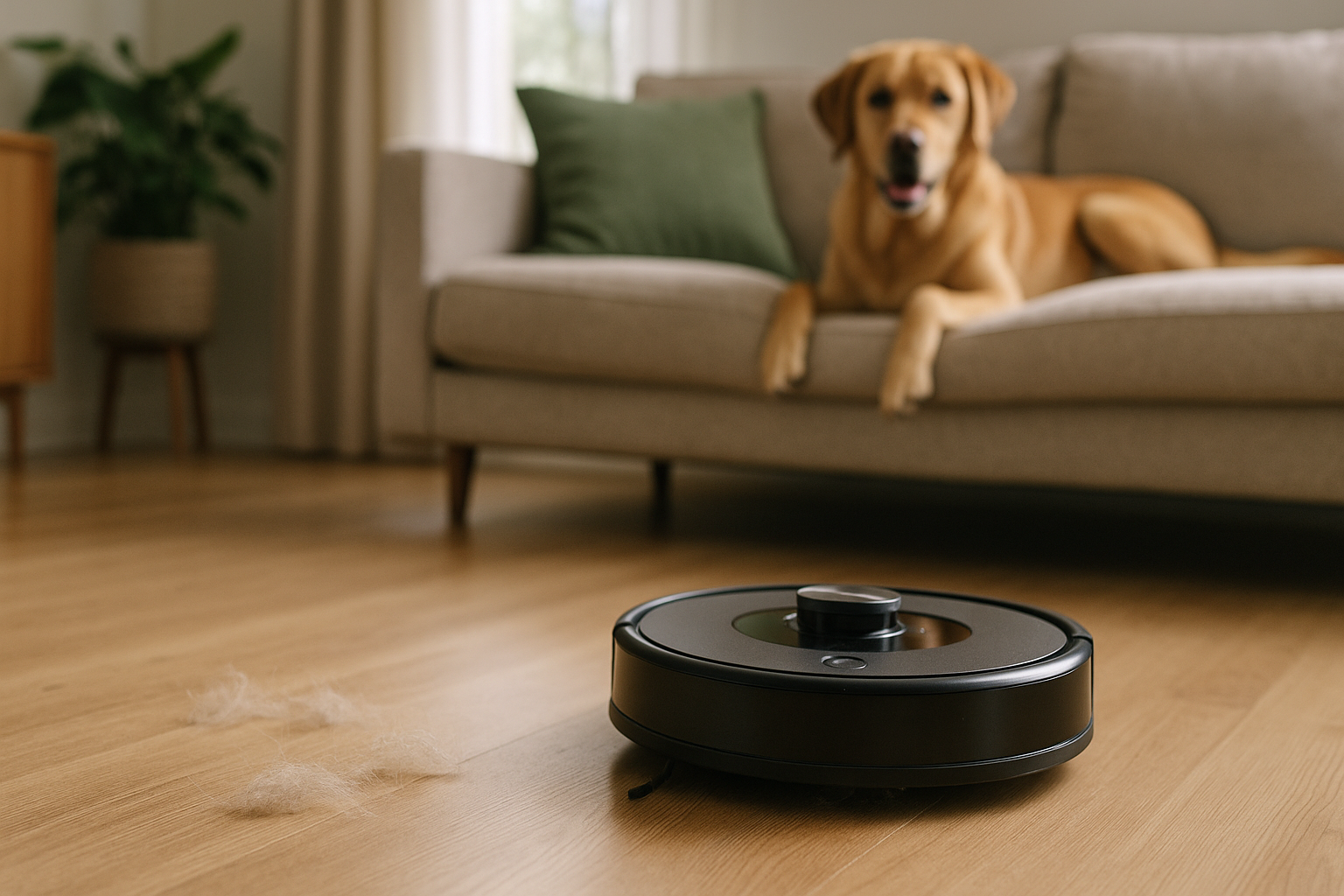
Is a Robot Vacuum Actually Worth It for Pet Hair? (The Honest Answer)
Short answer: yes, but only if you pick the right model and set realistic expectations. A $150 robot vacuum will not keep up with a double-coated Husky. A $450 Roborock, running daily, absolutely can.
The longer answer depends on your home, your pets, and how you define "worth it." If you have one low-shedding cat and hardwood floors, almost any mid-range robot vacuum will feel like magic. If you have two Golden Retrievers and carpet throughout, you need a specific class of machine — and you still need to run your upright every week or two for deep pile cleaning. This article breaks down exactly where robot vacuums earn their price tag and where they fall short.
How Much Pet Hair Can Robot Vacuums Really Handle?
A lot more than they could five years ago. Modern flagships like the Roborock S8 MaxV Ultra and iRobot Roomba Combo j9+ use rubber roller brushes specifically engineered to resist hair tangles — a genuine engineering leap from the bristle brushes that turned every cleaning cycle into a detangling nightmare.
In practical terms: a robot vacuum running once or twice daily in a home with two medium-shedding dogs can realistically eliminate 80–90% of surface pet hair between traditional vacuum sessions. That's not a made-up number — it aligns with what testers at Wirecutter, RTINGS, and independent Reddit communities consistently report after months of use.
Where robot vacuums struggle is deep-pile carpet (anything over ½ inch), thick clumps of wet hair, and hair that's worked into upholstery. On hardwood, LVP, and low-pile carpet? They're genuinely impressive.
Key Features That Separate Good Pet Hair Robot Vacuums From Bad Ones
Not all "pet" features on the box actually matter. Here's what does:
Brush Roll Design
Rubber roller brushes (not bristle) are non-negotiable for pet hair. They don't tangle. Roborock, iRobot's newer Roomba lines, and Shark all use rubber rollers in their mid-to-high tier models. Bristle brushes still appear in budget models under $200 and they will wrap with hair constantly.
Suction Power
Measured in Pascals (Pa). For pet hair on carpet, look for at least 2,500 Pa. Budget models often cap at 1,200–1,500 Pa. That's enough for hardwood but underwhelming on carpet. The Roborock S8 series hits 6,000 Pa. The Eufy X9 Pro hits 5,500 Pa.
Dustbin Size and Self-Empty Base
If you have a heavy shedder, a standard 0.4L dustbin fills fast. Self-emptying bases (like those on the Roomba j7+ or Roborock S8 Max Ultra) collect debris in a 2–3L bag you empty every 30–60 days. Worth the extra cost for multi-pet households.
Filtration
HEPA-style filters capture fine dander particles — critical if anyone in your home has pet allergies. Non-HEPA filters just redistribute fine particles into the air.
Navigation
Laser (LiDAR) navigation is faster and more systematic than camera-based or random-bounce navigation. It matters because thorough, predictable coverage means fewer missed hair deposits.
Best Robot Vacuums for Pet Hair Tested and Ranked (2026)
1. Roborock S8 MaxV Ultra (~$1,400)
The best all-around pet hair robot vacuum available. Self-empties, self-mops, self-cleans its own dock. 6,000 Pa suction, rubber roller brush, AI obstacle avoidance that recognizes pet waste (yes, really). Overkill for one cat. Justified for two-plus dogs.
2. IRobot Roomba Combo j9+ (~$900)
Exceptional pet hair pickup, excellent app, and the cleanest self-empty system on the market. The combo mop function lifts the pad automatically to avoid carpet — smart design. Slightly less suction than Roborock at 2,500 Pa, but the brush roll design and cleaning patterns compensate on most surfaces.
3. Roborock Q Revo (~$600)
The sweet spot for most pet owners. 5,500 Pa, rubber brush, self-empty dock, obstacle avoidance, and mopping. Performs within 10–15% of the S8 MaxV Ultra at less than half the price.
4. Shark Matrix Plus 2-in-1 (~$450)
A strong mid-range option. Matrix cleaning pattern means better coverage than older Shark models. HEPA filter, self-empty base, and pet hair performance that competes with units $150 more. Less sophisticated mapping than Roborock.
5. Eufy RoboVac X8 Pro (~$300)
Two motors, 4,000 Pa combined, surprisingly capable on carpet. Lacks a self-empty base at this price, but the suction-to-dollar ratio is excellent for hardwood-primary homes with moderate shedders.
Robot Vacuum vs. Traditional Vacuum for Pet Hair: Head-to-Head Comparison
| Feature | Robot Vacuum | Traditional Upright |
|---|---|---|
| Daily maintenance | Automatic | Manual |
| Deep carpet cleaning | Weak | Strong |
| Stairs | Can't do them | Yes |
| Pet dander removal | Good (HEPA models) | Excellent |
| Upholstery | No | Yes |
| Cost over time | Medium-high (parts) | Low-medium |
| Time saved | High | None |
The honest takeaway: robot vacuums don't replace traditional vacuums for pet owners. They reduce how often you need to run your upright. Think of it as a daily maintenance layer, not a full solution. Most serious pet owners run a robot vacuum daily and do a proper deep vacuum with a Dyson Animal or Miele once a week.
Hidden Costs Every Pet Owner Should Know Before Buying
The sticker price isn't the full story.
- Replacement filters: $15–$30 every 2–3 months for heavy-use homes
- Replacement brush rolls: $20–$40 per roll, needed every 6–12 months with heavy shedders
- Self-empty bags: $20–$35 for a pack of 3–6 bags (used every 30–60 days)
- Dock cleaning: Some self-empty/mop combos have proprietary cleaning solution refills at $10–$15/month
Budget an extra $150–$250/year in consumables if you have two or more pets. Factor that into the "worth it" calculation.
How Often Should a Robot Vacuum Run in a Pet-Heavy Home?
Once daily minimum. Twice daily if you have a heavy shedder like a German Shepherd, Samoyed, or Maine Coon. Pet hair accumulates fast, and the more frequently the robot runs, the less any single session has to deal with — which means more consistent suction performance and less brush roll tangling.
Most owners with multiple pets set schedules like this: - 7am: Full run while the family is at work/school - 6pm: Quick second pass through high-traffic areas (living room, hallways)
Most current models let you set room-specific schedules, so you don't need the full house cleaned twice — just the spots where pets actually spend time.
The Limitations: When a Robot Vacuum Simply Isn't Enough
Be honest with yourself about these scenarios:
Thick or shag carpet. Robot vacuums can't generate enough suction contact on high pile. Hair embeds deeper than the suction can reach. A Dyson V15 or Miele Complete C3 Cat & Dog is the right tool here.
Stairs. No robot vacuum handles stairs. Full stop.
Large clumps or fresh shedding. A freshly brushed dog dropping a tennis-ball's worth of fur in one spot can choke a robot vacuum's intake. Clear heavy clumps manually.
Pet accidents. Even models with "obstacle avoidance" for pet waste can fail. If your pet has any accidents, don't leave the robot running unsupervised until the area is cleaned.
Small, cluttered spaces. Robot vacuums need open floor space. If your home has a lot of furniture legs, cables, and toys on the floor, the robot spends more time stuck than cleaning.
What Real Pet Owners Say After 6+ Months of Use
Browsing r/RobotVacuums, r/dogs, and verified Amazon reviews tells a consistent story:
"Bought the Roborock Q Revo for my two Labs. Hair on the floor is basically gone between weekly deep vacuums. Would never go back."
"The Roomba j7+ was a game-ch.. It completely changed how I manage dog hair. I vacuum properly maybe once every 10 days now instead of every 2."
The consistent complaints: brush rolls still need regular maintenance, dustbins fill faster than expected in high-shed seasons, and cheaper models lose suction on carpet quickly. Nobody regrets buying a quality model. Plenty of people regret buying a cheap one.
Best Robot Vacuums for Pet Hair by Budget
Under $200
Eufy RoboVac 11S Max (~$160). Simple, reliable, 2,000 Pa. No self-empty, no mapping. Fine for one low-shedding pet on mostly hardwood. Don't expect carpet miracles.
$200–$500
Shark Matrix Plus 2-in-1 (~$450) or Eufy X8 Pro (~$300). The Shark wins if you want self-empty and mopping. The Eufy wins if raw suction on a budget matters most.
$500+
Roborock Q Revo (~$600) is the best value in this tier. For the top-of-market experience — particularly in multi-pet homes — the Roborock S8 MaxV Ultra or Roomba Combo j9+ justify the spend.
How to Get the Most Out of Your Robot Vacuum as a Pet Owner
- Declutter the floor before each run. Pick up toys, cables, and loose items. Takes two minutes and dramatically improves coverage.
- Clean the brush roll every 3–4 days. Even rubber rollers accumulate some hair over time.
- Empty the dustbin after every run if you don't have a self-empty base. Full bins lose suction fast.
- Use no-go zones to keep the robot away from the dog's water bowl, litter box area, or any spot where accidents happen.
- Brush your pets more frequently. Less loose hair on the dog = less hair on the floor = easier job for the robot. A Furminator session twice a week makes a measurable difference.
- Run during shedding season peaks (spring/fall) at maximum frequency. Some owners go to three runs a day in April.
Our Verdict: Which Pet Owners Should Buy One (and Who Should Skip It)
Buy one if: You have one or more pets that shed regularly, you're tired of seeing hair tumbleweeds by Thursday, and you're willing to spend at least $300 on a model with proper suction and a rubber brush roll.
Buy a premium model (~$600+) if: You have two or more heavy shedders, carpet throughout the house, or allergies that make dander management a genuine health issue.
Skip it if: Your home is mostly high-pile carpet, you live in a cluttered space the robot can't navigate, or your budget caps at $150 — that money is better spent on a quality cordless stick vacuum instead.
The best first step: pick the Roborock Q Revo if you're serious about pet hair and want self-emptying without spending over $700. Set it to run every morning for two weeks and compare how often you're reaching for your upright. Most people are surprised how much the math shifts in the robot's favor.